
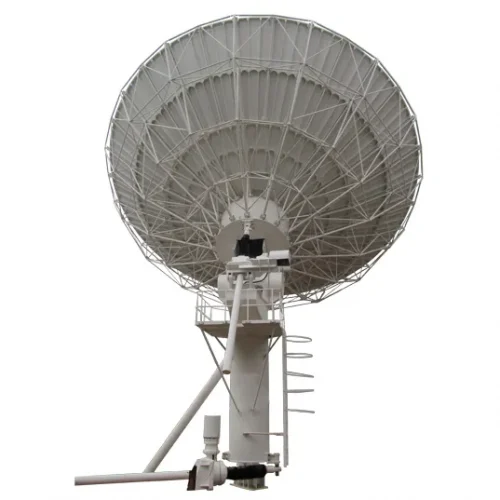
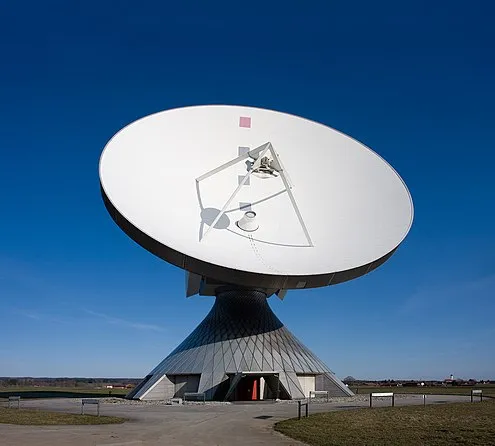

A parabolic reflector antenna, commonly known as a parabolic dish antenna, is a highly directional antenna that uses a parabolic reflector to focus radio waves into a narrow beam. It is widely used for high-gain applications such as satellite communications, radar, and radio telescopes due to its ability to focus electromagnetic waves with high precision.
Operating Principle
- Reflective Focusing: The parabolic shape ensures that parallel incoming radio waves are reflected to the focal point of the parabola. Conversely, waves emitted from the focal point are reflected outward in a parallel beam.
- High Gain and Directivity: The ability to focus waves tightly results in high gain and narrow beamwidth, making the antenna highly directional and capable of long-range communication.
Types of Parabolic Reflector Antennas
- Prime Focus: The feed antenna is located at the focal point of the parabolic dish. Simple and effective but can cause some blockage and shadowing.
- Offset Feed: The feed antenna is positioned off-axis, eliminating blockage and shadowing, often used in satellite TV dishes.
- Cassegrain: Uses a secondary reflector to direct waves from a feed antenna located at or near the dish surface to the main reflector’s focal point, reducing feed blockage and improving performance.